DESARROLLO DE UN PRODUCTO LÁCTEO TIPO HELADO USANDO COMO ACTIVO ANTIOXIDANTE PULPA DE CAÑAFÍSTULA (Cassia fistula)
DOI:
https://doi.org/10.22579/20112629.824Palabras clave:
Fruta, Industria alimentaria, Producto lácteo.Resumen
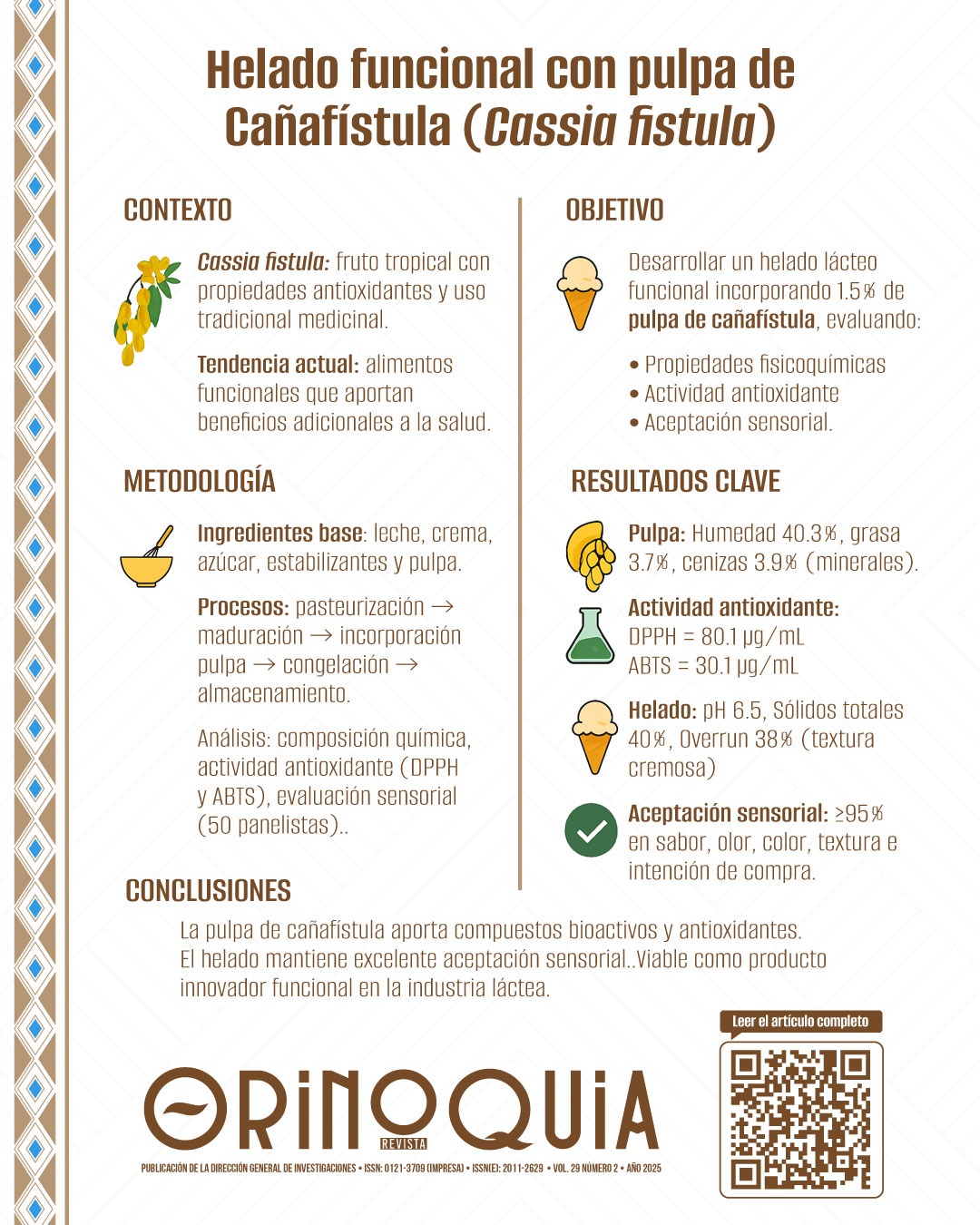
La elaboración de helados innovadores, como el que se ha desarrollado con Cañafístula en el ámbito de la tecnología alimentaria, abre un emocionante horizonte. Las propiedades únicas de la cañafístula pueden conferir al producto características distintivas en términos de sabor y potenciales beneficios para la salud; la actividad antioxidante, medida mediante DPPH• y ABTS•+, alcanzó valores de 80,10 ± 0,30 µg/mL y 30,1 ± 0,09 µg/mL, respectivamente. La meticulosa elección de ingredientes lácteos destaca no solo la creación de un producto singular y delicioso, sino también la importancia de buscar la máxima calidad posible. Los resultados del análisis sensorial del helado son destacables, evidenciando un alto porcentaje de aceptación (≥95%) en relación a los atributos sensoriales evaluados, tales como sabor, olor, color, textura e intención de compra. Este enfoque innovador no solo puede satisfacer las expectativas de los consumidores en búsqueda de experiencias gastronómicas únicas, sino que también demuestra el potencial de conquistar un amplio mercado.
Descargas
Referencias
AOAC. (1990). Official methods of analysis of the association of official analytical chemist, 15th ed. Methods 932.06, 925.09, 985.29, 923.03. Association of official analytical chemists. Arlington, VA, USA https://www.worldcat.org/title/official-methodsof-analysis-of-the-association-of-official-analytical-chemists/oclc/20709424
ANDI. (2022). Sectoral chambers. https://www.andi.com.co/Home/Camara/16-industria-de-alimentos
Carles-Barrios A, Colmenares A. (2018). Characterization of the physical and chemical properties of Cassia grandis (carao) and its application for the production of a nutritional biscuit. Universidad del Valle de Guatemala. Guatemala.
Centro Nacional de Información de Ciencias Médicas. (2014). Manual para la práctica de la medicina natural y tradicional. La Habana. Editorial de Ciencias Médicas. 226.
Cevallos AJ. (2022) The production process in the profitability of an ice cream factory in the city of Guayaquil. Universidad Cesar Vallejo. Piura-Perú.
Chagas-Barros R, Corrêa-Pereira U, Santana-Andrade J, Santos-De Oliveira C, Vieira-Vasconcelos S, Narain N. (2020). In vitro gastrointestinal digestion and probiotics fermentation impact on bioaccessbility of phenolics compounds and antioxidant capacity of some native and exotic fruit residues with potential antidiabetic effects. Food Research International. 136: 109614.
Dawood H, Mohamed S, Asmaa AE, Azza M, Ahmed AZ and Mohamed A. (2011). Chemical characterization of Cassia fistula polysaccharide (CFP) and its potential application as a prebiotic in synbiotic preparation. RSC Adv. 11: 13329. doi:10.1039/d1ra00380a
FAO. Milk production. (s/f). https://www.fao.org/dairy-production-products/production/es/
FAO. (2018). El futuro de la alimentación y la agricultura – Caminos alternativos hacia 2050. Organización de las Naciones Unidas para la Alimentación y la Agricultura. https://www.fao.org/3/I8429ES/i8429es.pdf
Faye B, Konuspayeva G. (2012). The sustainability challenge to the dairy sector– The growing importance of non-cattle milk production worldwide. International Dairy Journal. 24 (2): 50-56.
Goff, H. & Hartel, R. (2013). Ice Cream (7th ed.). Springer. https://doi.org/10.1007/978-1-4614-6096-1
Kader, A. (2002). Postharvest technology of horticultural crops (3rd ed.). University of California, Agriculture and Natural Resources.
Khatri, S., Jan, H.A., Abbasi, A.M., Bussmann, R.W., Paniagua-Zambrana, N.Y. (2021). Cassia fistula L. Cassia occidentalis L. Fabaceae. In: Kunwar, R.M., Sher, H., Bussmann, R.W. (eds) Ethnobotany of the Himalayas. Ethnobotany of Mountain Regions. Springer, Cham. https://doi.org/10.1007/978-3-030-57408-6_49
Kuskoski EM, Asuero AG, Troncoso AM, Mancini-Filho J, & Fett R. (2005). Aplicación de diversos métodos químicos para determinar actividad antioxidante en pulpa de frutos. Ciência e Tecnologia de Alimentos. 25(4): 726–732. https://doi.org/10.1590/S0101-20612005000400016
Lafourcade-Prada A, Rodríguez-Amado J, Escalona-Arranz J, Laurido-Fuenzalida C. (2014). State of the art in Cassia grandis L. f. (cañandonga). Revista Cubana de Plantas Medicinales 19(1):21-28.
Leon-Mendez G, Leon-Mendez D, Pajaro-Castro N, Granados-Conde C, Granados-Llamas E, Bahoque-Peña M. (2020). Preparation of a biscuit based on banana (Musa abb) and sweet potato (Ipomea batatas) flours. Rev Chil Nutr. 47(3): 406-410.
Montejo-Cuenca E, Castañeda-Sánchez M, Mastínez-Yero O, Pérez-Freeman F, Duvergel-Rosseaux, J, Ramírez-Sánchez W, Salgado-Acosta Y. (2005). The use of homolyzed and Canandonga (Cassia grandis) os reonstituent in calves’ malnutrition. REDVET. Revista Electrónica de Veterinaria. VI (9): 1-7.
Moreno J, Mesías V, Pérez O. (2022). Export of artisanal tropical fruit ice creams. Aula virtual. 3(8): 104-111.
Morillas-Ruiz, JM., & Delgado-Alarcón, JM. (2012). Nutritional analysis of vegetable food with different origins: Evaluation of antioxidant capacity and phenolic total compounds. Revista Nutrición Clínica y Dietética Hospitalaria. 32(2): 8-20.
Morón L, Caro Y, González R y Torres E. (2015). Obtaining a Substitute of Paste-type Chocolate using Carao pulp (Cassia fistula L.) Información Tecnológica. 26(6): 39-44. doi: 10.4067/S0718-07642015000600006
Muse, M. R., & Hartel, R. W. (2004). Ice cream structural elements that affect melting rate and hardness. Journal of Dairy Science, 87(1), 1–10. https://doi.org/10.3168/jds.S0022-0302(04)73135-5
Norma Técnica Colombiana (NTC). (2002). Ice cream and cream mix. https://www.midagri.gob.pe/portal/download/pdf/direccionesyoficinas/dgca/normatividad-lacteos/Colombia/NTC_Helados_y_Mesclas_para_Helados_1239.pdf
Oyewole TA, Oyewole ON and Falodun AE. (2022). Cassia Fistula Seeds Nutritional Profile; an Insight into its Therapeutic Potentials. Insi in Chem & Biochem. 2(2). doi: 10.33552/ICBC.2022.02.000533.
Re R, Pellegrini A, Proteggente A, Pannala A. (1999). Antioxidant activity applying an improved ABTS radical cation decolorization assay. Free Rad. Biol. Med.26:1231-37.
Silva B, Andrade P, Valentao P, Ferreres F, Seabra R, Ferreira M. (2004). Quince (Cydonia oblonga Miller) Fruit (Pulp, Peel, and Seed) and Jam: Antioxidant Activity. J. Agric. Food Chem. 52:4705-12.
Velaña-Sanchez JA, Aguayo-Santistevan M. (2021). Elaboration of a drink with antioxidant properties based on the mucilage of the cane Fistula (Cassia fistula L.) with passion fruit (Passiflora edulis L.). Universidad Agraria del Ecuador. Guayaquil – Ecuador.
Zapata-Osorio L, Rojano B, Morales D. (2021). Elaboración de un producto alimenticio funcional mediante el uso de pulpa liofilizada de guayaba agria (Psidium araca). Universidad Nacional de Colombia. Medellín, Colombia.
Descargas
Publicado
Licencia
Derechos de autor 2025 Orinoquia

Esta obra está bajo una licencia internacional Creative Commons Atribución-NoComercial-SinDerivadas 4.0.